Tuesday, 26 April 2011

Me then.


These are eight self portraits. They're all in order bar the first one. So clockwise from top left they are: 1990 drawing of me as a 14 yr old, 1984 first drawing at college, 1984 first ever oil painting, 1986 oils and compass, 1986 oil and pencil on paper, 1992 watercolour, 1996 oils (I was drunk when I painted it) and 1999 oil sketch.

Don't know if you learn anything from these, other than I got better at drawing, just thought I'd post them anyway.

Tuesday, 5 April 2011

Letting the puppet strings show.

"Why did you draw it like that?" you ask. Well, regardless of whether you ask that or not it's the question I'll try to answer in this post. Obviously I draw in a number of styles so the one I chose for 300 pages of Don Quixote was for a specific reason.

Firstly here's the glib answer for people who are afraid of talk about art (y' big babies!):

The reason I did it this way is because it's quicker and I need to do 6 pages a week to pay the bills.


What follows is the 'speak your brains' version, or 'the truth':

A phrase you'll hear a lot when people discuss the styles of comic artists is "Raw or Cooked", it's self explanatory really - Raw is unpolished, as it comes and Cooked is polished to 'perfection'. The traditional process for making comics has helped create these schisms. Most comic artists to this day still work in pencil stage and ink stage and the distinctive comic art look, so shakily mimicked by Roy Lichtenstein, is a result of the process. It was necessary for a hard black line in early comics due to the poor quality printing and so the art of 'inking' was born. As was the job of 'inker', something that is still entrenched in American comics. Despite the process driving the artist naturally towards the 'cooked', some inking let the brushwork say more about energy and texture than simple tracing. Better printing techniques gave artists even more opportunity to move over to the 'raw' side of the spectrum. Now we have comic art that's stretched the spectrum as far as it can go, just look at a book by Joann Sfar next to one by Chris Ware.

I use these two as examples because they are both successful storytellers, there are examples of both approaches where the style, regardless of how wonderful it looks, detracts from the story. Neither approach is guaranteed to tell the story better than the other, but it's important that telling the story is the intention in choosing an approach.

No prizes for guessing which side of the raw or cooked spectrum my Don Quixote work sits.

I imagine most artists' roughs look a bit like this, I want to retain some of the that manic energy in the final art.

The final line work is still very rough, but hopefully it masks some degree of sophistication.

I knew from the start that I would be looking for something ragged enough to reflect the setting, the characters and state of Don Quixote's mind. And coming back to the unclever reason, I did need to make the haste with which I'd be turning the book around work for me rather than against me. I dispensed with ink altogether and decided to scan my pencils.

That hasty, raw, pencil work was perfectly suited to the story, but as with all art there was a deception at its heart - there's no way I could put together whole pages of characters interacting in one continuous mad scribble, there is a lot of penciling just as with any comic art.

To prevent me from tightening up and polishing the line work unintentionally I draw onto a lightbox set up in such a way as to ensure I can't see the roughs too clearly, this means I'm never tracing, I'm looking to make definitive, if occasionally clumsy, marks.

Sometimes I'll switch to a stubby B pencil and work away from the lightbox to introduce shadows and texture.

I imagine it's obvious why the ragged look suits a rustic setting and characters, it may not be quite so obvious why that look reflects the state of Quixote's mind. Exposing the workings in a drawing has a long history in the 'fine arts', I still bear the scars of being taught by products of the Slade School where the process of building an observational painting is left on the surface for the viewer to see (the famous measuring ticks and crosses*).

This amounts to the artist showing us the puppet strings, it is telling us that it is a painting whilst another part of our brain is shouting that it's a person. That schism was explored in art long before the meticulous Slade painters arrived and in literature it was being explored over 400 years ago by Cervantes in the pages of Don Quixote.

Here the design is resolved digitally. It's about using negative shapes, so I'm roughing in colour. I do this a lot on Quixote. Don Quixote often becomes a squiggle, a kind of signature when he's in the background of a panel.

Here's the final art of that panel with the quick lines and fixed design working together.

How can we believe in a character from the pages of a book? How can we believe in a person who is just lines on a piece of paper? Cervantes knew this madness and pulled countless readers into it. It isn't really possible to adapt Don Quixote, it's an adaptation from a translation of a history of someone who is made up, all we can do as readers is join Cervantes inside this madness. And that's all I can do as writer and artist.

*See painters like Coldstream or Uglow for examples of this.

Thursday, 3 March 2011

The Lovecraft Anthology

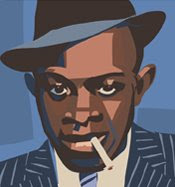
Reblogging the above image because I just received my copy of the Lovecraft Anthology, published by SelfMadeHero. And it is a really beautiful and creepy looking book! SelfMadeHero should be applauded for their choice of artists on this book, by using the cartoon stylings of artists like Mark Stafford, Shane Oakley, D'Israeli and Ian Culbard they have set themselves apart and given their anthology a distinct vision. It reminds me of the halcyon days of 2000ad in the late 70s and 80s seeing such strong, idiosyncratic styles together in one title. Funnily enough, current 2000ad favourite Leigh Gallagher also draws a story as does David Hartman (a new name to me, but another with a strong cartoon sense to his storytelling) and Alice Duke, whose painterly work has some magical touches in it. The book employs the writing talents of Ian Edgington, Dan Lockwood, David Hine, Leah Moore & John Reppion and, of course, me.

Just to be clear, I didn't draw anything in this book, and I couldn't have drawn my story, The Dunwich Horror, as well as Ian Culbard has anyway. If you're a fan of Ian's work you're in for a treat, I think this is his best work to date. If SelfMade ask me, and if time permits, I'd certainly like to draw in a 2nd Lovecraft Anthology. The above image was just done quickly for my own amusement. It's a picture of young Wilbur from The Dunwich Horror. If you don't know who he is then you should rush out to your local bookshop/comic shop and get a copy of this anthology. If you do know who he is then I imagine you've already got your coat on and are on your way to the shop.

Thursday, 24 February 2011

Doctor Who meets Miss Havisham

A page from the 'Time of My Life' from Doctor Who Magazine (reprinted in the Widow's Curse book), written by Jonathan Morris. Putting this up as another reminder that I'll be at the Cardiff Expo this weekend with Doctor Who wares (and a sketchbook). Hopefully I'll see you there.

Tuesday, 15 February 2011

The Immortal Emperor


This a comic strip form the Doctor who Storybook 2009, I drew it in May 2008. It's a fun story written by Jonathan Morris. Its significance to me is that it was my return to drawing comics professionally after a lengthy hiatus. There are some rusty moments in there, but I also had a lot of fun with it and I think that shows.

Sunday, 30 January 2011

Beaten Up!


Don Quixote and Sancho Panza get beaten up a lot in this book. I'm starting feel like I may be a bit punch drunk myself with it. I've done the losing your mind section and now I'm into the relentless beatings. It's funny, because that sounds like the plot for the story of many comic book heroes, especially Superheroes. Although, if this were a superhero story there would be a need to indulge a prepubescent wish fulfillment and have Quixote defeat the bad guys, plus Quixote would probably look a bit more like the victim of steroid abuse.

Needless to say this isn't that kind of book, even if it does lay down a story format that so many Superhero comics have picked up over the years. It's not fair to compare the two, but interesting none the less. In many ways Cervantes' genius can be seen in the way his view of the hero and the madman was framed in his mind alone and published in 1605 whereas it took the collected minds of many great writers 70 years to come to the same end-story in comics. In other words what Alan Moore did to 60+ years of superheroes, Cervantes did to his hero from page one. 400 years before.

Ah, but comics were never meant to be seen as great literature, I hear you say. Neither was Don Quixote. It was a popular entertainment, an amusement. It was read by the everyday Spaniards in streets and villages and read aloud to those who couldn't read.

This is not to say that I expect my comic book to turn out something on a par with Kirby, Moore et all (God, I wish!), no this is just to help communicate the idea of what Don Quixote was in the context of its time, and perhaps help people understand why it is so lauded.

As in the panel above, Quixote and Sancho spend a lot of time on their backs moaning. If there is something to admire about them physically it's their almost 'rope-a-dope Ali' ability to soak up pain.

There are a few more beatings in store for our heroes before Cervantes' story spreads into something wider, so I better pick them up so I can knock them down again. I feel their pain.

Thursday, 27 January 2011

Influence Map Mark II

Here's a variation on that Influence Map meme. I tried to replace my influences with images by me that showed that influence. I say 'tried' because it wasn't very straight forward as it turned out. I could have chosen virtually anything I've done to illustrate the influence of Mick McMahon, for example, what I chose is something from 1986 (a strip called Brother Grimm) to show how far back his influence goes. And in places I just looked for a kind of symmetry.

Anyway, hopefully it's still of some interest.


Wednesday, 26 January 2011

Cardiff Expo


In my first outing of the year I shall be attending the Cardiff International Comic Expo in the company of many other Doctor Who comicsy folk. I'll have a new batch of those big yellow Doctor Who prints for sale and will be sketching and signing for anyone who wants me to. I'll have some other Doctor Who stuff to sell and original art. The above has been turned into some rather nice cards. I'm short of time to do a new piece for Cardiff, but I did consider adding Doctor No. 11 to the above image and turning it into a print. Would anyone want one if I did? Be a bit like this rough design below I guess (with the addition of a Matt Smith scene bottom right of course).


Anyway, if you're there come over and say hello, I'll either be on the Doctor Who table with Dalek and TARDIS or at the Blank Slate table.


Wednesday, 29 December 2010

What shall we do in 2011?

Let's not, eh. It would be a waste of comics, and there is much comics to be made and much comics to be read over the next 12 months. My schedule is filled with Don Quixote until May when I'll take on a few other smaller projects before tucking into Quixote Vol. 2. I also have another project on the go that I'm acting as editor on. It was 'just an idea' a month ago and had anyone said:
that would have been the end of it. Someone didn't, in fact someone thought it was a good idea and now I'm committed to it. There will be announcement in a couple of months and you will all be duly excited. Unless you already know, in which case you'll probably say, "not that again...!"

That's the book making side of things, there is also the book reading side of things:

That's right, there will be books from me you can take home. There will be two books from SelfMadeHero that I've worked on out next year: Quixote Vol. 1 (of course) out in the Autumn and The Lovecraft Anthology, out in May, featuring The Dunwich Horror written by me and drawn by the irrepressible Ian Culbard.

It certainly is a strange tale, but then that's Lovecraft for you, he was a strange chap. The ear in question belongs to our friend Alonso Quixana.


Ouch!

All these illustrations, with the exception of Ian's, come from Don Quixote. The funny looking, green ones at the top are from the stories within stories that are a big feature of Quixote. No doubt I'll blog about that next year.

For now though I need to get my head down and draw. In that respect at least 2011 will be much the same as every other year.


Monday, 27 December 2010

Inside Soap

Here are some of the soap cartoons I've done over the past year for Inside Soap magazine. If you don't watch soap operas this probably won't mean a lot to you. Actually I don't watch them myself but I'm always well briefed by my editor, Gary Gillat. Most of the images are his ideas.

These pics are vaguely in the right order and you can see the point where I tried something different (the axe one), Gary liked it so much we changed approach from there on and ended up with images that are more interesting and often quite surreal.

Monday, 13 December 2010

Christmas Doctor Who!

December's Doctor Who Magazine is out in the shops today (or tomorrow depending on where you live). It contains a new comic strip written by Jonny Morris and drawn by me, called The Professor, The Queen and The Bookshop. Jonny and me have a good track record for bringing the best out in each other and this one certainly stretched me at times. I won't give away anything about the story, but both script and art are full of hidden treats.

The above image is page one sans lettering, the image below is from the last page.

I have to give a big thanks to Geraint Ford for his brilliant work on the colouring - painstaking flatting and ever patient with me and all my demands.

Friday, 3 December 2010

Who Wrote Don Quixote?

Hang on! If this fella is translating Don Quixote, whose words
are in the caption? Or is that what he's writing?

There's much sleight of hand and obfuscation around the authorship of Don Quixote, not like the conspiracy theory stuff that surrounds Shakespeare, the deception in Don Quixote is Cervantes' own. It's one of the reasons why adapting this book is far from the hollow task that some adaptation presents. I've become bound up in the metafiction and realise as I go forward how often the tools of comic storytelling lend themselves well to the overlapping narratives that Cervantes created.

Look at this fellow, for example. He's the unnamed translator of most of the book, for all we know he could have made it up. We rely on him to give us the true origin of the book and name its true author:
It's that kind of book. One minute you're wrapped up the crazy adventures of the two hombres next minute the whole notion of fiction collapses around you and it's your own sanity that comes into question.

Deception is an art. Art is deception, and everyone connected with Don Quixote, including Cervantes, Don Quixote, Sancho Panza, me and you are part of that deception. This crazy old man wants to be like a knight-errant; knight-errants only exist in books; Don Quixote makes himself like a book; Don Quixote is a book; we make him real; Cervantes makes him real; he outlives Cervantes and you and me...

Maybe I've been overdoing the Night Nurse or maybe this book has got to me. OR... Maybe this book has to get to me otherwise I'll never pull off the deception.
 
Site Meter