Sunday, 30 January 2011

Beaten Up!


Don Quixote and Sancho Panza get beaten up a lot in this book. I'm starting feel like I may be a bit punch drunk myself with it. I've done the losing your mind section and now I'm into the relentless beatings. It's funny, because that sounds like the plot for the story of many comic book heroes, especially Superheroes. Although, if this were a superhero story there would be a need to indulge a prepubescent wish fulfillment and have Quixote defeat the bad guys, plus Quixote would probably look a bit more like the victim of steroid abuse.

Needless to say this isn't that kind of book, even if it does lay down a story format that so many Superhero comics have picked up over the years. It's not fair to compare the two, but interesting none the less. In many ways Cervantes' genius can be seen in the way his view of the hero and the madman was framed in his mind alone and published in 1605 whereas it took the collected minds of many great writers 70 years to come to the same end-story in comics. In other words what Alan Moore did to 60+ years of superheroes, Cervantes did to his hero from page one. 400 years before.

Ah, but comics were never meant to be seen as great literature, I hear you say. Neither was Don Quixote. It was a popular entertainment, an amusement. It was read by the everyday Spaniards in streets and villages and read aloud to those who couldn't read.

This is not to say that I expect my comic book to turn out something on a par with Kirby, Moore et all (God, I wish!), no this is just to help communicate the idea of what Don Quixote was in the context of its time, and perhaps help people understand why it is so lauded.

As in the panel above, Quixote and Sancho spend a lot of time on their backs moaning. If there is something to admire about them physically it's their almost 'rope-a-dope Ali' ability to soak up pain.

There are a few more beatings in store for our heroes before Cervantes' story spreads into something wider, so I better pick them up so I can knock them down again. I feel their pain.

Thursday, 27 January 2011

Influence Map Mark II

Here's a variation on that Influence Map meme. I tried to replace my influences with images by me that showed that influence. I say 'tried' because it wasn't very straight forward as it turned out. I could have chosen virtually anything I've done to illustrate the influence of Mick McMahon, for example, what I chose is something from 1986 (a strip called Brother Grimm) to show how far back his influence goes. And in places I just looked for a kind of symmetry.

Anyway, hopefully it's still of some interest.


Wednesday, 26 January 2011

Cardiff Expo


In my first outing of the year I shall be attending the Cardiff International Comic Expo in the company of many other Doctor Who comicsy folk. I'll have a new batch of those big yellow Doctor Who prints for sale and will be sketching and signing for anyone who wants me to. I'll have some other Doctor Who stuff to sell and original art. The above has been turned into some rather nice cards. I'm short of time to do a new piece for Cardiff, but I did consider adding Doctor No. 11 to the above image and turning it into a print. Would anyone want one if I did? Be a bit like this rough design below I guess (with the addition of a Matt Smith scene bottom right of course).


Anyway, if you're there come over and say hello, I'll either be on the Doctor Who table with Dalek and TARDIS or at the Blank Slate table.


Wednesday, 29 December 2010

What shall we do in 2011?

Let's not, eh. It would be a waste of comics, and there is much comics to be made and much comics to be read over the next 12 months. My schedule is filled with Don Quixote until May when I'll take on a few other smaller projects before tucking into Quixote Vol. 2. I also have another project on the go that I'm acting as editor on. It was 'just an idea' a month ago and had anyone said:
that would have been the end of it. Someone didn't, in fact someone thought it was a good idea and now I'm committed to it. There will be announcement in a couple of months and you will all be duly excited. Unless you already know, in which case you'll probably say, "not that again...!"

That's the book making side of things, there is also the book reading side of things:

That's right, there will be books from me you can take home. There will be two books from SelfMadeHero that I've worked on out next year: Quixote Vol. 1 (of course) out in the Autumn and The Lovecraft Anthology, out in May, featuring The Dunwich Horror written by me and drawn by the irrepressible Ian Culbard.

It certainly is a strange tale, but then that's Lovecraft for you, he was a strange chap. The ear in question belongs to our friend Alonso Quixana.


Ouch!

All these illustrations, with the exception of Ian's, come from Don Quixote. The funny looking, green ones at the top are from the stories within stories that are a big feature of Quixote. No doubt I'll blog about that next year.

For now though I need to get my head down and draw. In that respect at least 2011 will be much the same as every other year.


Monday, 27 December 2010

Inside Soap

Here are some of the soap cartoons I've done over the past year for Inside Soap magazine. If you don't watch soap operas this probably won't mean a lot to you. Actually I don't watch them myself but I'm always well briefed by my editor, Gary Gillat. Most of the images are his ideas.

These pics are vaguely in the right order and you can see the point where I tried something different (the axe one), Gary liked it so much we changed approach from there on and ended up with images that are more interesting and often quite surreal.

Monday, 13 December 2010

Christmas Doctor Who!

December's Doctor Who Magazine is out in the shops today (or tomorrow depending on where you live). It contains a new comic strip written by Jonny Morris and drawn by me, called The Professor, The Queen and The Bookshop. Jonny and me have a good track record for bringing the best out in each other and this one certainly stretched me at times. I won't give away anything about the story, but both script and art are full of hidden treats.

The above image is page one sans lettering, the image below is from the last page.

I have to give a big thanks to Geraint Ford for his brilliant work on the colouring - painstaking flatting and ever patient with me and all my demands.

Friday, 3 December 2010

Who Wrote Don Quixote?

Hang on! If this fella is translating Don Quixote, whose words
are in the caption? Or is that what he's writing?

There's much sleight of hand and obfuscation around the authorship of Don Quixote, not like the conspiracy theory stuff that surrounds Shakespeare, the deception in Don Quixote is Cervantes' own. It's one of the reasons why adapting this book is far from the hollow task that some adaptation presents. I've become bound up in the metafiction and realise as I go forward how often the tools of comic storytelling lend themselves well to the overlapping narratives that Cervantes created.

Look at this fellow, for example. He's the unnamed translator of most of the book, for all we know he could have made it up. We rely on him to give us the true origin of the book and name its true author:
It's that kind of book. One minute you're wrapped up the crazy adventures of the two hombres next minute the whole notion of fiction collapses around you and it's your own sanity that comes into question.

Deception is an art. Art is deception, and everyone connected with Don Quixote, including Cervantes, Don Quixote, Sancho Panza, me and you are part of that deception. This crazy old man wants to be like a knight-errant; knight-errants only exist in books; Don Quixote makes himself like a book; Don Quixote is a book; we make him real; Cervantes makes him real; he outlives Cervantes and you and me...

Maybe I've been overdoing the Night Nurse or maybe this book has got to me. OR... Maybe this book has to get to me otherwise I'll never pull off the deception.

Sunday, 14 November 2010

Things to buy at Thought Bubble


Long post this one, and unusually it's mostly about other people's work. This weekend (all being well) I'll be at Thought Bubble comic con in Leeds and hopefully I'll see lots of you there. I will be selling posters and postcards and original art again, but this time from the Blank Slate table which will be at the end of the big ol' Forbidden Planet table. The only new addition to the posters I had for sale at BICS is the Solipsistic Pop 3 poster above. Here are the others:

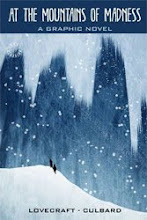
If I'm not at the Blank Slate table you may find me at the Solipsistic Pop table helping give the Solipsistic Pop 3 book it's official launch. There's a long shot that I may be lurking around my own publisher's table because SelfMadeHero will be there with their increasingly excellent list of titles. I won't be adding to the list until next year, but my friend and inspiration Mr Ian Culbard will have his new adaptation of At The Mountains of Madness by HP Lovecraft on sale and will be sketching and signing at the event.

BUY \

Ian's adaptation is perhaps the best of his SelfMadeHero books. Here "Britain's answer to Darwyn Cooke" works in double page spreads and uses the broader space to give us snowy vistas, frozen oceans, alien cityscapes and vast mountain ranges. The writing is stripped down and the book zips by, in stark contrast to the heavy going Lovecraft texts. All is rendered in Ian's trademark style, a kind of Yves Chaland/Frank Robbins lovechild.
As I know from struggling through my adaptation of The Dunwich Horror (which Ian has drawn and, in my opinion, is his best strip work yet!), voice overs are pretty inevitable in Lovecraft comic adaptations. Here the best sequences are where Ian shakes off the voice over and lets the characters play off one another or the action move seamlessly. If I have any criticism of the book, it's really a criticism of the source material - and that's the characterisation. I didn't really care about them. Lovecraft's characters are flat; he's all about ideas and the characters too often become cyphers. What Lovecraft excels at is spiking the imagination with his poison and enveloping the reader with a sense of menace beyond our ken. Ian's version loses non of that. You won't buy a better Graphic Novel or comic at Thought Bubble, don't hesitate to get it.

So when you've got you Solipsistic Pop 3, some of my posters and At The Mountains of Madness what else can you spend your pennies on....? Well, seeing as you'll be standing at the Blank Slate table I suggest you buy as many of their books as you can because I can't think of a comic publisher with a higher hit rate. All things going to plan I will be adding to their list with something of my own, something I'm so excited about I need to move on before I blurt. What there will be on the table is the standard Blank Slate excellence in the shape of Oliver East's books (Oliver's work is truly unique, check it out), Psychiatric Tales by Darryl Cunningham (the comic book that even mum's love!), books by the brilliant Mawil and the hilarious Speenal by Nigel Auchterlounie, (check them all out here) plus the two newest editions: Sleepyheads by Randall.C and The Girl and the Gorilla by Madeliene Flores. Buy both!

Image of Sleepyheads - Randall C. - Hardcover Version

Sleepyheads is a quite beautiful object. It's drawn in a style I instantly fell in love with: flat, tattered, desaturated colour swatches for panels and wonderfully realised characters scrawled across the pages with deceptive ease. I could eat a book like this. The question is would the story match up? Well, a story about dreams with characters strolling from one dreamscape to the next could have been a real let down - how do you relate to characters in a story like this? Why should you care what happens when you know that it will end with every kid's favourite first story ending "then I woke up and it was all a dream"?
By coincidence I read this at the same time I was reading Sleepyheads. Any comic about dreams will always make me think of Little Nemo and Bill Watterson's comments ("I can’t read the strip without thinking how much more enchanting Slumberland would be if the characters, rather than the backdrops and costumes, advanced the story") in that piece had me questioning what made Nemo work for me. The answer is that sometimes a comic or book just has a feeling to it that you can only reach via reading that piece of work. Perhaps we shouldn't let our tastes and biases make demands upon what comics should be, they're still in their infancy I think, we don't know that answer.
So back to Sleepyheads, what does it offer? Well, strangely enough it offers more than most comic books I've read this year. The dream logic means the strip morphs from one thing to the next, but there is a real structure as the story flits between the two characters trapped in a dream and two Russian sailors stuck on a desert island. The book has an inescapable intrinsic logic of it's own and asks questions about perception that might spring open a few minds. The chapter about the Senoi and whether their perception meant the Spanish invaders were invisible to them is an anthropological idea I've always been in love with and underpins a lot of my own ideas about perception. If I have a criticism of the book it's just that I don't see why it had to be framed as a dream. I would have preferred it with the going into and out of the dream chopped off and let the reader be the dreamer. Who's to say though the balance between crediting the reader with intelligence and going over their heads is always a tricky one.


Girl and the Gorilla is a simpler story in a sparser style told on bare white pages with deftly described figures that I followed faithfully from the first page on. The story is a 'through the looking-glass' affair in which a fed up girl called Aurelie is transported to a world of creativity where books roam free like wild animals, buildings are constructed of a writer's words and there's a newspaper reading Gorilla who acts as a kind of spirit guide for writers. The Girl and the Gorilla is an all ages book that reads like a kids book adults can enjoy, I was reminded of The Phantom Tollbooth. The great success of this book is that it makes storytelling not just its most important aspect but its very reason to exist.

Back to Thought Bubble, I haven't seen the programme for the Saturday, but I believe I may be listed in the programme as signing and sketching at 10:30 to 12:00. I won't be there, I've told you where to find me and if you want a signing or sketching I will of course oblige. The good news is my ridiculously talented friend Simon Gane will be signing and sketching on that table instead, so get him to draw you a girl. He draws great girls. He's even better at drawing street scenes but that would be a bit of an unfair request.

Right, sales pitch over, normal service (me talking about me) will resume next week.

Monday, 8 November 2010

Observer/Cape Graphic Short Story Prize


First time I've reposted something. I won't make a habit of it. I always planned to repost this after the 2010 Observer/Cape prize was announced mainly because I've connected with more followers via Twitter and the blog and I thought you/they might like to see it.

As it happens this year's winner is one of the people who commented on the original post and someone I have real admiration for (his comment seems quite ironic now). You can see Stephen Collins' winning entry here, although it worked best in the full spread of the Observer Review section yesterday. Hopefully this exposure will lead to a Stephen Collins book, something I'd happily pre-order now.

The style of Stephen's strip is a kind of metamorphosis/magic realism that I've always loved, a style I will always associate with the short story Axolotl by Julio Cortazar. As I said to him via Twitter yesterday it also reminded me of Dylan Thomas's Map of Love. Literary allusions aside what makes this so great is that it is a comic strip and it could only be a comic strip. It's in a different league to previous winners and gives the prize a genuine credibility many felt it lacked.

There's a suspicion among many UK creator's that Observer and Cape have a fear of comics and feel the need to throw an arty or literary veil over comics to give them credibility. This ignores the real quality of great literature and art - they are of their own form and are often great precisely because they are aware of their own form. A comic strip that could only be a comic strip. Stephen Collins' strip is precisely that - what it is not is a 'Graphic Short Story'.

It's comic strip, and it's a bloody good one.

Thursday, 4 November 2010

Autobiographical comics


Press copies of Solipsistic Pop 3 have gone out, the launch party is next week, and my mind has taken a break from Quixote to go through that wonder-what-people-will-think-of-it phase about my contribution to SP3 (just like everyone else no doubt). This is a bit like a flashback to 1989 and the first issue of SLANG. I'm pretty thick-skinned about most of the published work I do, but my SP3 strip is probably my first autobiographical work to hit print since SLANG.

Autobiographical comics are the oxygen of the small press, in many cases they reflect the mundanity of the everyday - the minute details of personal hygiene and tiny fissures in personal relationships. There are of course some wonderful examples of this and some that are eye-curlingly bad. Mine tend to be slightly veiled, 'semi'-autobiographical sort of stories that deal with the more traumatic aspects of my life.

Back in the late 80s my main strip for SLANG dealt with much of the same stuff that you'll find in The Torturer's Garden (that's the SP3 strip). In a way things have come full circle. At the top of this post is a panel from The Torturer's Garden and below is a panel from SLANG No 2.


Damaged youths in bovver boots, and there's that Dennis the Menace jumper. It may not look like most people's idea of an autobiographical comic, but my thoughts about it are the same as anyone who has done this kind of comic are - have I exposed too much of myself? will people be judging me rather than the art? etc etc

You know, the good thing about this anthology is that I'm in such great company, it really does contain some of the most talented and original creators working in UK comics right now. Even if my approach and/or subject matter isn't to people's liking there are so many other approaches to comics on show here that, if you love comics, you will love this book.

Saturday, 30 October 2010

Don Quixote and the Truth of Colour


Quixote sneaks out first thing in the morning, so early the sky is green.

I'll start with a mammoth digression (hang in there):

My good friend/Landlord/illustration mentor, Mike Charlton, and I once spent an entire lunch break arguing about truth in colour. We sat on his porch looking out over sunny Salisbury with him taking up his post-war rationalist opposition to my post-acid arty position, we pointed out shadows and highlights and bickered about their true colour. The conclusion he drew, in his usual acerbic manner, was that I either had a visionary eye for colour or I was just making it up. Now we weren't arguing about the existence of fairies or aliens, but the insinuation was the same - his argument was that the colours you see in Van Gogh are not what he sees they are an invention of the imagination. My argument (and yes, Mike, I'm still here making it!) is that art is about learning how to see so you let other people see too.
Hmmm... you can see the weight of Mike's case about me being full of shit - he's the one who made me see art as a job rather than some airy fairy mission to understand. The irony is Mike would use colour in a visionary way, but he'd just say he was doing what worked best for the picture not what the world really looked like to him.

I can't help wondering how much the arrival of photography impacted on how we see and what we believe about 'how things really look'. It is an aspect of seeing (with one-eye) that tells us so much, but not everything.

What has this got to do with cartooning, you ask, is he about to launch into a tirade against comic artists who trace photos for a living? Well, no, this is just a preamble to me showing you a few panels from Don Quixote Volume One. And the thing that you'll probably notice is the colours are a bit wangdoodle.
I've long found myself with a foot in both camps when it comes to drawing comics - out and out cartooning, with its possibilities for the pictures becoming graphemes, on one side and more 'realistic' action comic art, with its attraction of turning the mechanics of light and shade to schematics on the other. But with colour I don't see that dichotomy. Hopefully the drawing doesn't show the constant wrestling between cartoony and realisticy as a problem.

Don Quixote has given me the opportunity to put all of my ideas into practice - the book is all about perception and deception after all - I may well fall flat on my face like Quixote does, but I love the idea of being either a visionary or full of shit. Comics let you do that, and there's an audience for both.

This follows the big panel at the top of the post. It's later in the morning on the same day. the heat is in the land already, but the sky is still waking up.
It's late in the day when he arrives.

That night at the inn and Quixote gets in a scrap. The night in this case is ochre, I wanted the night to feel warm.

Daft idea this - I tried to mix my colours of warm night with my green morning to give a symbolic lighting. It's a portentous moment and I borrowed the composition from those famous knight getting dubbed illustrations of yore. Of course the pomposity of the whole thing undermined somewhat.

And off he trots. It's another day and another green morning.

This last one is representative of the whole of chapter two where all the backgrounds are bright yellow. It's a hot day, ok? I have a feeling the look of this chapter may have been influenced by the old Kia-Ora ad.

Thursday, 21 October 2010

Solipsistic Pop Launch

Solipsistic Pop 3 is printed, the free gifts and stickers are ready and the date for the Launch party has been announced. Tom Humberstone has done an amazing job putting this together, I have pdf of the book and I think it's the best British anthology I've seen.
The stories are varied, but with a central theme built around being readable to all ages and having the flavour of D.C.Thompson comics of the past. My own effort (two images above) is a fairly dark autobiographical thing, but all the stories have a different tone without ever clashing.

Something I've come to realise since starting this blog and joining Twitter is just how many ridiculously talented cartoonists there are in Britain, many of them unpublished, and this book reflects that. I'm just glad I'm around and making comics now.

Below is the flier for the Launch Party, it features some artwork from David O'Connell's strip (yes, the book is that good!). I look forward to meeting the other contributors and other jolly comics' folk.

 
Site Meter